How to Send Money from Japan to the US, Canada, or Europe: Compare Fees, Conditions, and the Amount Received
EDITORIAL NOTE · 31 JULY 2026
Originally published 17 May 2025. This article was reviewed on 31 July 2026 using information published by the providers, banks and public bodies cited below. Fees, exchange rates, limits, eligibility, supported routes and estimated delivery times may change. Confirm the current quote and conditions directly with the provider before sending money.
Advertising and affiliate disclosure: This article contains affiliate links to Wise. If you open or use a Wise account through one of these links, remarkable. may receive compensation. This does not increase your cost. Affiliate compensation does not influence the services considered, the analysis or the conclusions.
When sending money from Japan, the visible transfer fee is only one part of the cost. A useful comparison should also consider:
the exchange rate used;
any fee charged by the funding method;
possible intermediary or receiving-bank charges;
how the recipient receives the money;
the transfer limit and identity checks; and
the final amount the recipient is expected to receive.
For a normal transfer from Japan to a bank account in the United States, Canada or a European country, Wise may provide a convenient starting point because it displays the rate, fee, expected receiving amount and estimated delivery time before confirmation. A bank transfer may be more appropriate when branch support, an existing banking relationship or additional transaction documentation is important. Seven Bank’s Western Union service is primarily useful when the recipient needs to collect cash.
There is no single cheapest method for every amount and destination. Compare like with like immediately before sending.
Why the total cost is not always obvious
A traditional international bank transfer may involve several separate components: the sending-bank fee, the exchange rate, a yen or foreign-currency handling fee, and possible intermediary or receiving-bank charges.
As one current example, MUFG lists an online outward-remittance fee of ¥2,500 for certain MUFG overseas destinations and ¥3,000 to other banks. Its branch/Web Support route is ¥7,000. Depending on the currency and account used, an additional handling fee of 0.05%, with a minimum of ¥2,500, may apply. Other-bank or intermediary charges can also arise. These figures are examples from one bank, not a universal market price.
Mizuho states that outward remittances are handled at selected branches, that an appointment may be required, and that customers may need documents supporting the source, purpose and recipient of the transfer. This illustrates another practical difference: the comparison is not only price, but also process and the degree of human support.
Wise: current Japan rules to understand
Wise Payments Japan K.K. is licensed and registered as a Type I and Type II Funds Transfer Service Provider with the Kanto Local Finance Bureau, registration No. 00040.
Wise states that it uses the mid-market exchange rate and shows its fee before a transfer is confirmed. The actual fee depends on the amount, currency route and funding method, so a fixed fee range quickly becomes outdated.
For a transfer funded in JPY, Wise currently accepts:
a bank transfer from an account in the user’s own name; or
an eligible debit card.
Wise’s JPY transfer guidance states that credit cards, cash deposits and third-party payments are not accepted for JPY funding.
Transfer limits
For a Wise profile registered in Japan, an eligible transfer created through Send and funded from an external method such as a bank account or card may be sent up to ¥150 million equivalent under the Type I service.
The ¥1 million figure still applies to certain different activities, including sending directly from a Wise balance and adding money to the account. It should not be described as a general “new-user daily limit.” Wise explains the distinctions in its Japan large-transfer guidance.
Additional evidence about the source of funds or purpose of a large transfer may be requested.
Identity and address verification
Wise’s Japan verification guidance currently requires:
an accepted Japanese photo ID;
a valid My Number document, unless the My Number Card itself is used as the ID; and
matching name, date of birth and Japanese address information.
Accepted photo ID differs for Japanese nationals, permanent residents and long-term visa holders. A valid My Number Card, a qualifying residence card, a Japanese driver’s licence or certain older Japanese passports may be accepted in the situations Wise specifies.
A My Number Card is therefore convenient, but it is not the only possible combination of documents.
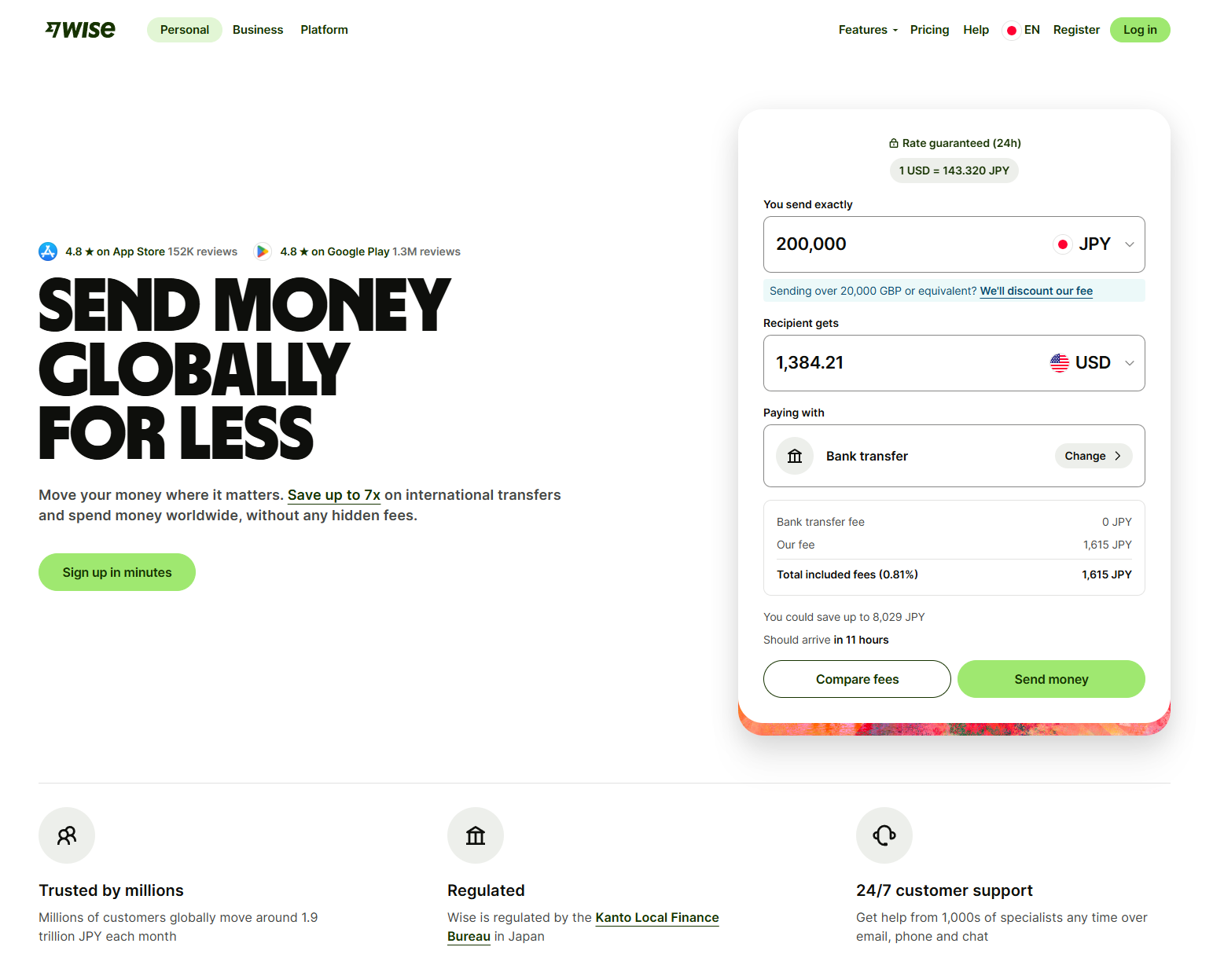
How to send money with Wise
Start a transfer in the Wise website or app and enter the sending and receiving currencies.
Enter the amount.
Review the exchange rate, fee, expected amount received and estimated arrival time.
Complete identity and address verification when requested.
Enter or select the recipient’s bank details.
Choose one of the funding methods actually shown for the route. For JPY, this is generally bank transfer or an eligible debit card, not a credit card.
Pay and follow the transfer status in Wise.
Check the current fee, exchange rate and receiving amount with Wise.
The figure shown before confirmation is more useful than a fee quoted in an undated article because it reflects the actual amount, destination and funding method selected.
The following article sources readily available information and was published on May 17th, 2025 JST.
Sending money abroad from Japan — whether to the US, Canada, or Europe — has historically been expensive, slow, and inconvenient. If you’re a student, freelancer, expat, or business owner, you’ve likely faced:
High fixed fees from banks (¥3,000 - ¥5,500 per transaction)
Unfavorable, opaque currency exchange rates
Long wait times for the money to arrive
Language barriers when using JP-based services
Thankfully, there’s a globally trusted and Japan-licensed solution that makes international transfers simple and low-cost: Wise.
Decision guide
Comparing the main options
Each method solves a different transfer problem. Compare the receiving method, total cost, documentation and support—not only the advertised sending fee.
Bank-account route
Wise
Often suitable for
Personal or business transfers to a supported overseas bank-account route.
Recipient receives
Usually a bank-account payment in the destination currency.
Check before sending
Live fee, exchange rate, expected amount received, funding method, transaction limit and delivery estimate.
Bank-supported route
Japanese bank
Often suitable for
Transfers where branch assistance, an existing banking relationship or formal bank documentation matters.
Recipient receives
A bank transfer, often through the international banking network.
Check before sending
Sending fee, exchange rate, handling fee, intermediary and receiving-bank charges, and required documents.
Cash-pickup route
Seven Bank / Western Union
Often suitable for
Situations where the recipient needs to collect cash rather than receive a routine bank-account payment.
Recipient receives
Cash pickup across the Western Union network. Seven Bank also identifies account-credit routes for China and the Philippines.
Check before sending
Transfer fee, exchange-rate spread, pickup location, country limit, ATM fee and current service availability.
When Seven Bank may be more suitable
Seven Bank’s Western Union service can be useful when the recipient does not have a suitable bank account or needs to collect cash.
The service requires a Seven Bank account and an international money-transfer agreement. Transfers are made through a Seven Bank ATM or Direct Banking. Seven Bank states that this Western Union service is not sent through its international-remittance app, although the app provides other functions.
Seven Bank currently publishes sending fees from ¥400 to ¥2,000 depending on the amount, destination and receiving method. Its exchange rate includes a spread, and an additional out-of-hours ATM fee may apply. Because the applicable rate and recipient amount can change, use Seven Bank’s live simulation before sending.
For routine payments to US, Canadian or European bank accounts, cash pickup is often less convenient than a direct bank-account route. For emergency cash or a recipient without a bank account, it can solve a different problem from Wise or a bank wire.
Japan residents and short-term visitors
Japanese citizenship is not required to use a Japan-registered Wise profile. Permanent residents and long-term visa holders can complete verification using the combinations of Japanese ID and My Number documentation specified by Wise.
A short-term visitor will generally not have the Japanese address and My Number documentation required to verify a Japan-registered profile. Someone who already has a Wise profile registered in another supported country should follow the rules for that registered country rather than attempting to register as a Japan resident.
Frequently asked questions
Is a My Number Card required?
Not in every case. A valid My Number document is required for the Japan verification process, but Wise may accept another specified Japanese photo ID together with a valid My Number document. The exact combination depends on residency status and the verification route.
Can I pay in JPY and have the recipient receive USD, CAD or EUR?
Yes, when Wise supports the selected route. Enter the recipient’s destination currency and bank details, then review the quoted fee, rate and receiving amount before payment.
Can I fund a JPY transfer by credit card?
No. Wise’s current JPY guidance permits bank transfer or an eligible debit card and says that credit cards are not accepted.
What is the transfer limit?
An eligible Japan-based transfer funded externally through Wise’s Send flow can be up to ¥150 million equivalent. Lower limits apply to other actions, including sending directly from a Wise balance or adding money. The limit displayed for the specific transaction controls.
Is Wise regulated in Japan?
Yes. Wise Payments Japan K.K. is licensed and registered as a Type I and Type II Funds Transfer Service Provider with the Kanto Local Finance Bureau, registration No. 00040. Regulation does not eliminate every operational or fraud risk, so confirm the recipient and use the official site or app.
Which method is cheapest?
It depends on the amount, currencies, funding method and receiving method. Compare the final amount received—not only the advertised sending fee—using live quotes obtained at approximately the same time.
Conclusion
For a supported bank-account transfer, Wise is worth including in a live comparison because it shows the exchange rate, fee and expected receiving amount before confirmation. A bank may be preferable when branch support or transaction documentation matters. Seven Bank’s Western Union service is a practical alternative when cash pickup is the priority.
Before sending, compare the same amount and destination across the relevant services and confirm:
how much leaves your account;
how much the recipient is expected to receive;
how and when the recipient will receive it; and
what identity, purpose-of-payment or source-of-funds evidence may be required.